


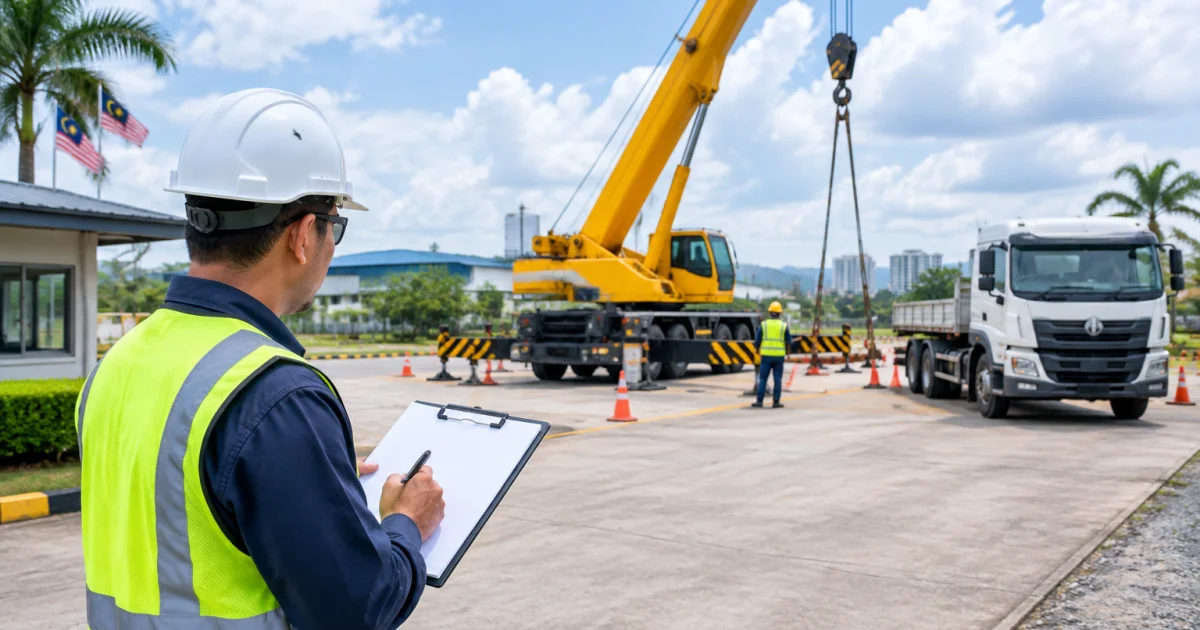
One-day lifting jobs look simple on paper: “bring crane, lift item, pack up.” On real sites in Penang—busy factories, narrow commercial lanes, live warehouses, or tight construction footprints—the difference between a smooth one-day lift and a delayed, overrun job is almost always preparation.
This tutorial is for project managers and site supervisors who need fast turnaround and want to book a crane penang rental with confidence. You’ll learn what information to send, how to check access and setup space, and a realistic timeline you can run like a mini project plan. Where relevant, we’ll note when a lorry crane, forklift, or skylift is the better tool for part of the workflow.
Step 1: Define the lift clearly (what, where, when, and success criteria)
Before contacting a provider, define the lift in practical site terms. This speeds up quotation, correct crane selection, and setup planning.
1) What exactly is being lifted?
- Item: machine, chiller, steel beam, generator, HVAC equipment, precast panel, container, etc.
- Dimensions: L/W/H (approx. early on; confirm before booking).
- Weight: use nameplate/manual/supplier packing list whenever possible. If unsure, state that clearly.
- Lift points: lugs/eyes, whether a spreader beam is needed, or if slings must be wrapped/choked.
- Restrictions: must stay vertical, no tilting/side load, vibration limits, fragile surfaces.
2) From where to where?
- Pick: inside factory, loading bay, roadside, rooftop, mezzanine, behind a fence line.
- Set: foundation, skid base, truck bed, roof plinth, plant room.
- Reach and height: distance from crane setup to pick/landing points, and required lift height.
3) When must it happen?
- Date window: include a backup day (weather and readiness affect one-day lifts).
- Preferred time: early morning for traffic, or during a shutdown window.
- Operating constraints: production hours, noise limits, lorry access hours/curfews, security time slots.
4) What does “done” mean?
State the success criteria so the provider can plan time and resources accurately:
- “Lift onto roof and land on skids in final orientation.”
- “Unload from low loader and place at staging area; client will align after hook is released.”
- “Set steel truss into position; crane holds while client bolts, then release.”
“Place-and-go” is very different from “hold while align,” and it affects duration, crane configuration, and crew.
Step 2: Prepare the site information the crane team will ask for
Most booking delays come from missing basics. If you include the items below in your first WhatsApp/email, you’ll reduce back-and-forth and get a more accurate recommendation.
Share these 10 items in your first enquiry
- Site address + pin: include the correct entrance gate and internal directions (“Gate B, security post, then left to Loading Bay 3”).
- Lift-day contact: name/phone of the person who can make on-the-spot decisions.
- Date/time window: include site access time, not just “lifting time.”
- Load details: weight, dimensions, lifting points, and clear photos.
- Pick-and-place sketch: annotated photo or hand sketch showing setup area and load path.
- Radius (approx.): setup-to-pick and setup-to-landing distances.
- Height constraints: canopies, pipe racks, gantries, power lines, building eaves, trees.
- Ground condition: concrete, compacted soil, interlock, road shoulder, basement deck; note new slabs, voids/manholes.
- Access constraints: narrow turns, ramps, height limits, public-road restrictions, security checks/time slots.
- Scope boundaries: who supplies rigging gear, who provides signalman/banksman, and whether a forklift/skylift is needed.
If possible, add a short walk-through video from the entrance to the setup point; for one-day jobs it often replaces a site visit.
Step 3: Do access checks like a crane planner (not just “can the truck enter?”)
A crane needs room to position, extend outriggers, and operate safely. Treat access as a quick mini survey using a tape measure and phone.
A) Measure the route from road to setup point
- Gate width/height: include beams, sign frames, cable trays.
- Tightest turn: confirm the crane can complete it without hitting barriers/kerbs.
- Internal road width: account for parked vehicles, stacked pallets, temporary fencing.
- Surface condition: potholes, soft shoulders, slopes, drainage channels.
B) Check for overhead hazards
Common Penang site issues include pipe racks, bay canopies, high-mast lights, and nearby power lines. Record:
- Clearance heights along the route
- Closest overhead obstruction at setup and within the swing area
- Any site “no-go” zones
If power lines are nearby, flag it early so the provider can plan a safe setup and machine choice.
C) Confirm setup footprint (outriggers and working area)
For a one-day lift, ensure the setup area is:
- Level enough for outrigger leveling
- Free of underground risks (manholes, culverts, trenches, recently backfilled zones)
- Large enough for outriggers plus a barricaded perimeter
Tip: mark the crane pad with cones or paint the day before to avoid conflicts with other trades and deliveries.
D) Confirm load path and landing zone
- Is the landing zone ready (base frame, anchor bolts, skids)?
- Will tag lines be used to control rotation?
- Is there clearance to detach slings safely after landing?
If landing on a roof or elevated slab, confirm structural capacity with your engineer before locking the date.
Step 4: Choose the right crane type for a one-day lift (and when a lorry crane is enough)
For short-duration work, the “right crane” is the one that completes the lift safely within the window with minimal disruption—not necessarily the biggest. Selection depends on load, radius, height, ground, and access.
Mobile or rough terrain crane (common for factory and construction sites)
- Best for: heavier loads, longer radius, quick setup, mixed site conditions.
- Considerations: needs proper outrigger space and adequate ground bearing.
Crawler crane (when ground is challenging or lifts are heavier/longer)
- Best for: uneven/soft ground, higher stability needs, longer-duration lifting scope.
- Considerations: mobilization is usually slower; not ideal for simple one-day lifts unless required.
Lorry crane (great for “deliver + lift” short jobs)
If the job is a straightforward unload-and-place at short radius—especially when transport and lifting are combined—a lorry crane can be efficient and reduce coordination.
If you’re unsure whether to use a lorry-mounted solution, read: How Lorry Cranes Make Construction Projects In Penang Easier.
For typical capacity categories, see:
- 5 ton lorry crane lifting capacity
- 8 ton lorry crane lifting capacity
- 10 ton lorry crane lifting capacity
- 15 ton lorry crane lifting capacity
Important: capacity drops as reach increases. Always share your estimated radius and landing height for confirmation.
When a crane is not the only equipment you need
Many one-day lifts overrun because the crane arrives on time, but the load or work area isn’t ready. Common support equipment:
- Forklift: staging the load at the pick point; removing packing/skids quickly.
- Skylift: access at height (guiding landing, roof edges, installing lifting beams, removing obstructions).
- Low loader/self loader: controlled transport for oversized loads.
Align arrival times so the crane isn’t waiting while the load is still being moved.
Step 5: Provide the minimum technical inputs to avoid “surprise constraints” on lift day
You don’t need to be a lifting engineer, but you do need to remove unknowns that trigger last-minute crane changes or repositioning.
A) Confirm actual weight and center-of-gravity risk
If weight is underestimated, the selected crane may be insufficient at the required radius. If weight is not confirmed, provide your best estimate and flag uncertainty. Mention anything that may shift the center of gravity (offset motors, one-sided compressors, partially filled tanks).
B) Share lifting point photos
Close-up photos of lugs/eyes help riggers choose sling angles, shackle sizes, and whether a spreader beam is needed. If there are no lifting points and slings must wrap the body, state it upfront.
C) Identify “hold and align” tasks
Precision placement and alignment can add significant time. If the crane must hold while you align bolt holes or position equipment:
- Confirm who performs alignment (your team or hired riggers)
- Prepare anchor bolts, shims, and tools in advance
- Allow schedule slack for fine positioning
D) Confirm ground bearing risks and outrigger support approach
You don’t need to calculate pressures, but you should disclose if setup is on interlock/pavers, backfilled ground, near drains/culverts, or on a basement/suspended deck. If some outrigger zones are restricted, mark them on a sketch/photo so the provider can advise a safe alternative.
Step 6: Build a realistic booking timeline for a one-day lift (from first call to pack-up)
One-day doesn’t mean “arranged in one hour.” It becomes fast when information and approvals are ready.
48–72 hours before: initial enquiry and site confirmation
- Send the 10 enquiry items (address, load, radius, photos, constraints).
- Confirm if a site visit is required or if photos/video are sufficient.
- Align internally on shutdown window, access permissions, and who is the lift coordinator.
24–48 hours before: finalize scope and readiness
- Confirm crane type/capacity and arrival window.
- Confirm any additional equipment (forklift, skylift) and coordinate timing.
- Clear the route and reserve the crane pad (move vehicles/materials, open gates).
- Prepare safety basics: barriers/cones, exclusion zone, pedestrian/traffic detours.
Evening before: “site is ready” checklist
- Load is staged at (or can be moved quickly to) the pick point
- Landing area ready (base/skids/clearance)
- Overhead obstructions identified and managed
- Security/gate access confirmed for crane arrival
- Responsible persons and phone numbers circulated
Lift day: a simple run-of-show
- Arrival and induction: guide crane to setup point; verify route is clear.
- Setup: outriggers positioned/leveled; working zone barricaded.
- Pre-lift briefing: roles, signals, lift sequence; confirm one point of command.
- Test lift: raise slightly to confirm balance and rigging behavior.
- Main lift: execute plan; use tag lines if needed.
- Landing and unrig: stable landing and safe sling removal.
- Pack-up: clear barriers, restore access, confirm no issues.
Assign someone to resolve blockers immediately (blocked gate, delivery truck, repositioning due to radius, unclear landing position). That’s how a one-day job stays one-day.
Step 7: Coordinate people and responsibilities (so the crane isn’t waiting)
On short jobs, idle time is the fastest way to exceed the day. Reduce it by assigning roles and keeping decisions centralized.
Minimum roles to assign
- Lift coordinator (your side): owns readiness, access, and final placement requirements.
- Signalman/banksman: directs positioning and lifting (confirm who supplies).
- Riggers: attach slings/shackles/spreader beam as required (confirm who supplies).
- Area marshal: controls exclusion zone and keeps pedestrians/vehicles out.
Clarify who provides rigging gear
Don’t assume slings and shackles are included. Confirm during quotation/booking:
- Are slings/shackles/spreader beams provided?
- Are tag lines provided?
- Is a signalman included, or must the site provide one?
If you use your own certified gear, ensure it’s suitable for the weight and sling angles; share what you have if you want the provider’s recommendation.
Step 8: Common one-day lift problems in Penang sites—and how to prevent them
Use this as a quick pre-mortem: assume something will go wrong, then remove the causes before the crane arrives.
Problem 1: The crane can’t reach due to underestimated radius
Prevention: measure from the realistic setup point to pick and landing points. If the crane must stand further back due to soft ground/obstacles, the radius increases. Share wide photos so the provider can plan.
Problem 2: Setup pad is blocked by other trades or deliveries
Prevention: reserve the pad with cones/tape and notify other teams. If the site is active, assign someone to keep it clear from early morning.
Problem 3: The load isn’t at the pick point when the crane arrives
Prevention: stage the load the day before when possible. If not, pre-book a forklift and crew to move it immediately and coordinate with production to clear aisles.
Problem 4: Overhead obstructions force a last-minute reposition
Prevention: scan for lights, cable trays, eaves, trees, and power lines. Take a wide photo and mark what can’t be moved; remove temporary obstacles (e.g., signboards) before lift day.
Problem 5: Landing area isn’t ready for final placement
Prevention: confirm skids/base plates and access to detach rigging. If orientation matters, mark landing direction with tape/chalk and pre-stage shims/tools for alignment.
Problem 6: A different machine would be faster/safer
Prevention: describe the end-to-end workflow, not only the lift. A lorry crane may be ideal for a single drop; a skylift may solve an access-at-height bottleneck; extra transport may be required for oversized loads.
Practical examples: two typical one-day lift scenarios (and what info to send)
Use these as templates for a “good enquiry.”
Example A: Factory chiller replacement (unload + place on skid)
- Location: Bayan Lepas industrial area. Gate A entry, loading bay behind Block 2.
- Load: packaged chiller, 3.2m x 1.6m x 2.1m, 6.5 tons (supplier packing list). 4 top lifting lugs (photos attached).
- Pick: low loader at loading bay.
- Place: onto skids in staging area 12m from setup; final alignment by client team after hook release.
- Constraints: canopy at 5.2m; pipe rack nearby; keep fire route open.
- Notes: forklift available; working window 8:30am–12:30pm.
Example B: Steel beam lift at construction site (set into position and hold)
- Location: Perai construction site. Entry via temporary gate; turning radius tight (video attached).
- Load: steel beam 11m, 2.2 tons each, 6 pieces. Web slings; spreader beam recommended (no lifting lugs).
- Pick: laydown area.
- Place: set on columns at Level 2 (~9m); hold while bolts installed (10–15 minutes per beam).
- Constraints: limited setup footprint; compacted soil with backfilled trenches (marked on sketch).
- Notes: banksman assigned; exclusion zone barricaded; request positioning advice.
Both examples include what providers need to plan quickly: weight, dimensions, radius/height, constraints, and whether the crane must “hold” or simply “place.”
Conclusion: the fastest way to book a one-day crane lift is to remove unknowns
Fast booking comes from clear scope and complete site info. Define the lift, share load details and constraints, check access and setup footprint, and confirm roles and responsibilities. With those basics in place, the provider can recommend the right equipment—mobile, rough terrain, crawler, or lorry crane—and execute safely within your one-day window with minimal disruption.
Frequently Asked Questions
What information do I need to provide when booking a one-day crane lift in Penang?
At minimum, share: site address and exact gate/entry, contact person on lift day, date/time window, load weight and dimensions, photos of the load and lifting points, estimated distance (radius) from crane setup to pick and landing points, overhead obstacles (canopies, pipe racks, power lines), ground condition at the setup area, and any access constraints like narrow turns or height limits. A short walk-through video from the entrance to the setup point helps speed up confirmation.
How far in advance should I book a crane for a one-day lift?
If you want the best chance of securing the right crane and avoiding delays, aim to initiate the enquiry 48–72 hours before the lift. That window allows time to confirm load details, resolve access issues, and coordinate supporting equipment like a forklift or skylift. If the job is urgent, many lifts can still be arranged faster, but you’ll need complete site and load information ready to share immediately.
Can I use a lorry crane instead of a mobile crane for a short lifting job?
Sometimes, yes—especially when the job is “deliver + lift + place” at a short radius and moderate height, such as unloading materials or positioning equipment near the truck. However, lifting capacity decreases as reach increases, so the key factors are load weight, required radius, and landing height. Share these details with the rental provider so they can confirm whether a lorry crane is suitable or if a larger mobile crane is safer and more efficient.
What access checks should I do before the crane arrives on site?
Confirm gate width/height, the tightest turning point, internal road width, and any slopes or soft shoulders. Check overhead hazards like canopies, cable trays, trees, and nearby power lines. At the setup point, ensure there is enough flat, stable space for outriggers and a barricaded working zone, and identify underground risks such as manholes, culverts, trenches, or recently backfilled areas.
Do you provide other equipment like forklifts or skylifts for lift-day support?
Many one-day crane lifts run smoother when supporting equipment is coordinated. Depending on your workflow, you may need a forklift to stage the load at the pick point, or a skylift to support high-access tasks such as guiding landing, accessing roof edges, or removing obstructions. If you tell the provider your full workflow (not just the lift itself), they can advise what additional equipment would help keep the job within the planned time window.
Plan a One-Day Lift with Tw Dynamic
If you’re arranging a short-duration lift in Penang, Tw Dynamic can help you select the right crane setup and coordinate supporting equipment so your site is ready on the day. Share your load details, lift radius, photos, and access constraints, and our team will advise a practical plan for a safe, efficient one-day operation.
We support industrial and construction sites across Northern Malaysia with mobile and rough terrain crane rental, crawler crane rental, lorry crane rental, forklift rental, skylift rental, and low loader/self loader services—backed by well-maintained equipment and flexible rental options.