


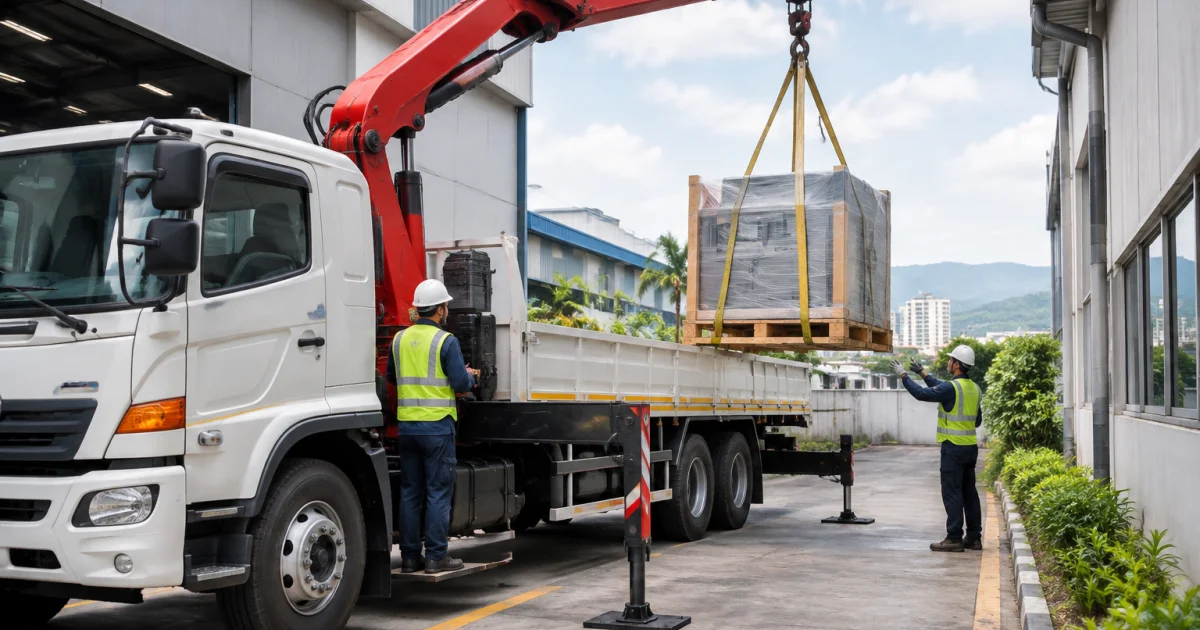
In Kulim, many “crane jobs” are not pure lifting jobs. They’re delivery jobs with a lift at the end: unload a crated machine at a factory bay, place a chiller on a mezzanine, shift pallets into a warehouse corner, or move equipment between two nearby sites in a single day. In those scenarios, I often see one solution outperform the rest: the Lorry Crane Kulim setup—because it combines transport and lifting in one mobilization.
This is an opinion piece based on how tight-site industrial work typically plays out: access limitations, short notice scheduling, and the reality that you may only get a short window to lift before operations resume. A mobile crane can be the right choice for many lifts, especially heavier or longer-reach picks. But for compact sites and same-day delivery + placement, a lorry crane frequently wins on speed, simplicity, and total coordination effort.
The real problem: it’s rarely “just a lift”
When contractors compare a mobile crane versus a lorry crane, the comparison is often framed around rated tonnage. That’s important, but it’s not the full picture. In the tight-site, urgent-delivery world, the bigger question is: How many separate moving parts do you need to coordinate to complete the job?
Think of a common industrial scenario in Kulim:
- A machine arrives on a truck and must be placed within a tight loading bay.
- The site has limited turning radius, parked vehicles, and a narrow access lane.
- The receiver wants the unload and placement completed quickly to reduce disruption.
With a mobile crane, you may still need separate transportation (a truck or low loader) and potentially a forklift rental to position items after the lift. With a lorry crane, the same vehicle can bring the load and lift it off—often reducing the handoffs that cause delays.
Why lorry cranes feel “faster” on compact sites
Speed isn’t just how fast the hook goes up and down. On constrained sites, speed is often defined by setup, access, and reset time. This is where lorry cranes often beat a mobile crane for same-day delivery jobs.
1) One mobilization: transport + lifting together
The biggest practical advantage is that a lorry crane can function as a delivery truck and a lifting solution. When the load is on the same vehicle as the crane, you often reduce:
- Coordination between transporter and crane operator
- Waiting time if either party arrives late
- Extra transfers (truck-to-ground-to-final position)
For a warehouse, engineering contractor, or machinery mover, fewer parties usually means fewer schedule risks—especially when the job is booked with short lead time.
2) Easier access in tight compounds
Many industrial sites around Kulim have compact guardhouse entries, narrow internal roads, and limited staging areas. A mobile crane can require additional space for positioning and safe working radius, and the truck carrying the load also needs its own access and parking plan.
A lorry crane still needs safe outrigger placement and working clearance, but it can be simpler to position because the vehicle bringing the load is the crane itself. On tight sites, that can translate into a more straightforward traffic plan: one vehicle in, unload, lift/place, one vehicle out.
3) Less site “rearranging” to create a lifting zone
In real operations, site teams often have to move parked cars, shift pallets, or clear a lane to create a lifting zone. When a job requires both a transporter and a separate crane, you’re clearing space for two different vehicles and their movement. With lorry cranes, you’re often clearing space for one.
That difference matters when you’re trying to complete a job between production shifts or during a limited receiving window.
Where a lorry crane can beat a mobile crane (and where it won’t)
It’s important to separate opinion from what’s physically required. A mobile crane exists for good reasons: heavy loads, longer reach, difficult picks, and engineered lifts. If your job needs those capabilities, a lorry crane is not a replacement.
But if your job is primarily a lift-and-transport task—especially for same-day delivery—lorry cranes can be a better fit.
Better fit use-cases
- Unload-and-place machinery at factory bays where a forklift alone can’t reach or handle the center of gravity safely.
- Positioning crated equipment onto a platform, into a setback area, or over a low wall with a controlled pick.
- Multiple small lifts in one run where the truck carries items and performs sequential placements.
- Short-notice jobs where speed of mobilization is more critical than maximum lifting performance.
Jobs where a mobile crane usually makes more sense
- High-capacity lifts where the load weight, radius, or lift plan demands larger crane charts.
- Long-reach placement over obstacles, deep into a site, or where the crane must sit far from the set point.
- Complex lifts needing advanced rigging setups, tandem lifts, or engineered controls.
The takeaway is simple: don’t choose based on “crane type” alone. Choose based on the full job workflow—delivery, access, lift radius, placement accuracy, and how many moves you can eliminate.
A practical decision checklist for tight-site lifts in Kulim
If you’re a contractor, warehouse supervisor, or machinery and equipment company trying to decide quickly, here’s a practical way to evaluate the job. None of these points replace an on-site assessment, but they help you ask the right questions before booking.
- Is the job actually delivery + placement? If yes, a lorry crane can reduce separate transport arrangements.
- How tight is the access route? Consider gate width, turning radius, overhead obstructions, and internal traffic.
- What is the required lift radius? Tight sites often force a crane to work at less-than-ideal positions; radius affects capacity heavily.
- Where will outriggers sit? You need stable ground and adequate clearance. Plan for safe setup, not just “it can fit.”
- Do you need follow-up positioning? If final alignment needs a forklift, pallet jack, or skates, plan it upfront.
- How many separate lifts are there? Multiple small items can be efficient with a single lorry crane run.
- What’s the downtime cost? If operations must resume quickly, fewer vehicles and fewer transfers often reduce delays.
You’ll notice “forklift” appears in this checklist—because many tight-site moves are hybrid jobs. It’s common to lift off a truck with a crane and then fine-position with a forklift rental once the load is on the ground or a stable landing area.
How to plan a same-day delivery + lift without creating delays
Same-day jobs fail for predictable reasons: incomplete details, poor access assumptions, and last-minute surprises like overhead cables or blocked bays. If you want the lorry crane approach to pay off, treat planning as part of speed.
Share the “five photos” that save hours
Before mobilization, it helps to share:
- Entrance/gate approach photo (showing road width and turning)
- Loading bay or unloading point photo
- Final set-down location photo (including nearby obstacles)
- Ground condition photo where outriggers would land
- Overhead photo angle if possible (to spot beams, canopies, or lines)
Even on quick jobs, these visuals reduce back-and-forth and help confirm whether a lorry crane is suitable—or whether a mobile crane (or different capacity) is required.
Be specific about “place” versus “drop”
Some clients only need the item unloaded onto the ground. Others need precise placement onto plinths, into a tight corner, or aligned for installation. Those are different jobs. Precise placement can affect rigging choices, manpower, and time on-site.
Consider complementary equipment for the last two metres
Even if a lorry crane performs the main lift, you may still need equipment for final positioning:
- A forklift for short-distance moves and alignment
- Skates/rollers for controlled indoor movement
- A skylift if technicians need elevated access for installation, piping, or cabling after placement
This doesn’t weaken the case for a lorry crane; it strengthens it. The fastest projects are planned as a sequence: transport → lift → land safely → position accurately → access for installation.
Choosing the right capacity: why “bigger” isn’t always better
Another reason lorry cranes often win for tight-site work is that overspecifying equipment can create unnecessary complications. A bigger crane may require more space, more setup constraints, and more site disruption. For compact delivery lifts, right-sizing matters.
Capacity choice should be driven by the real lift conditions: load weight, lift radius, boom configuration, ground conditions, and how the load is rigged. If you’re unsure, the safest approach is to share the load details and site constraints early and let the provider recommend the appropriate lorry crane capacity class.
To understand available options, it can help to review a provider’s lorry crane range and capacity categories before you request a quote.
Useful next reads
- Browse lorry crane options for different job sizes
- See when a 10-ton lorry crane capacity class may fit
- Explore higher capacity lorry crane choices for heavier loads
Conclusion: for tight sites and urgent deliveries, simplify the workflow
A mobile crane is a powerful tool, and for many heavy or long-reach lifts it’s the correct choice. But for the day-to-day reality of tight compounds, compact loading bays, and same-day delivery + placement, a lorry crane often beats a mobile crane because it simplifies the job into one coordinated move.
If you’re planning a lift in Kulim, the best question to ask is not “Which crane is bigger?” It’s “How do we complete transport, unloading, and placement safely with the fewest handoffs and the least disruption?” In many cases, that’s where a lorry crane becomes the practical, schedule-friendly answer.
Frequently Asked Questions
When should I choose a lorry crane instead of a mobile crane in Kulim?
Choose a lorry crane when the job is delivery plus lifting (unload-and-place), the site is tight, and you want one vehicle to handle both transport and the lift. Choose a mobile crane when you need higher capacity, longer reach, or a more complex engineered lift plan.
What information do you need to quote a lorry crane job for a tight site?
Typically: load weight and dimensions, pickup and delivery locations, photos of the entrance and unloading area, the required set-down point, any overhead obstructions, and whether final positioning needs a forklift or other handling equipment. These details help confirm capacity and safe outrigger placement.
Can a lorry crane replace a forklift rental for unloading machinery?
Sometimes, but not always. A lorry crane is great for lifting off the truck and placing onto a safe landing area. A forklift is often still useful for the last movement and alignment on the ground, especially inside warehouses or along narrow aisles.
How do I know if my site has enough space for outriggers and safe lifting?
Check for stable ground, clearance from drains/voids, and adequate distance from walls, vehicles, and pedestrian routes. Share site photos and the intended lifting position with the rental provider so they can advise whether the setup is feasible and what needs to be cleared.
Is Yit Leong Crane Services Sdn Bhd the same company as Tw Dynamic?
No. They are separate companies. If you are comparing providers, focus on whether the fleet, capacity range, site support, and scheduling responsiveness match your job requirements.
Need lift-and-transport support for a tight site in Kulim?
Tw Dynamic supports same-day style delivery-and-lift workflows with a well-maintained fleet and flexible rental options. If your job needs one coordinated move—transport, unloading, and placement—talk to our team about lorry crane rental (5-ton to 15-ton capacity), plus complementary equipment like forklift rental, mobile/rough terrain cranes, skylifts, low loaders/self loaders, crawler cranes, telescopic equipment, and static concrete pump support when required.
Share your pickup/delivery points, load details, and a few site photos, and we’ll help you shortlist the most practical setup for your schedule and site constraints.